
Hybridization of Company Offices
Transforming Your Office Footprint into Strategic Advantage
At Douglass Advisory we guide you through the multi-year transition from legacy office networks to a streamlined, hybrid-first workplace model—optimizing for productivity, cost,carbon and exit value.
Key Benefits:
~30% Reduction in Office Costs, Employee Attrition reduced ~33%, ~20% reduction in training costs, ~40% Increase in employee productivity, Average per employee savings per year-~$11,000
Challenges We Solve
Addressing the real estate pressures shaping the modern workplace.
Rising Lease Costs
Underutilized Office Space
Employee Flexibility Needs
Long-Term Closure Or Downsizing Planning
Learn More About Our
Process
A data-driven framework for designing a smarter, healthier, and more efficient workplace.
Workforce Data Mapping
We analyze where employees live, how they work, and how teams interact—using geospatial analytics to understand true clustering, commute patterns, and optimal office locations.
Scenario Modeling
We simulate multiple real estate and workforce configurations to identify cost, productivity, and cultural trade-offs, helping you choose the strongest long-term footprint.
Multi-Year Planning
We build phased downsizing or consolidation roadmaps that minimize disruption, align with lease expirations, and support business continuity.
Financial & Cultural Analysis
We assess the financial impact of each scenario while evaluating employee experience, collaboration needs, and cultural implications to ensure balanced decisions.
Policy Development
We craft hybrid policies—including attendance guidelines, space usage rules, and performance standards—tailored to your organization’s operational realities.
Implementation Support
We assist with vendor coordination, communication planning, workspace changes, and ongoing adjustments to ensure your hybrid strategy launches smoothly and stays on track.
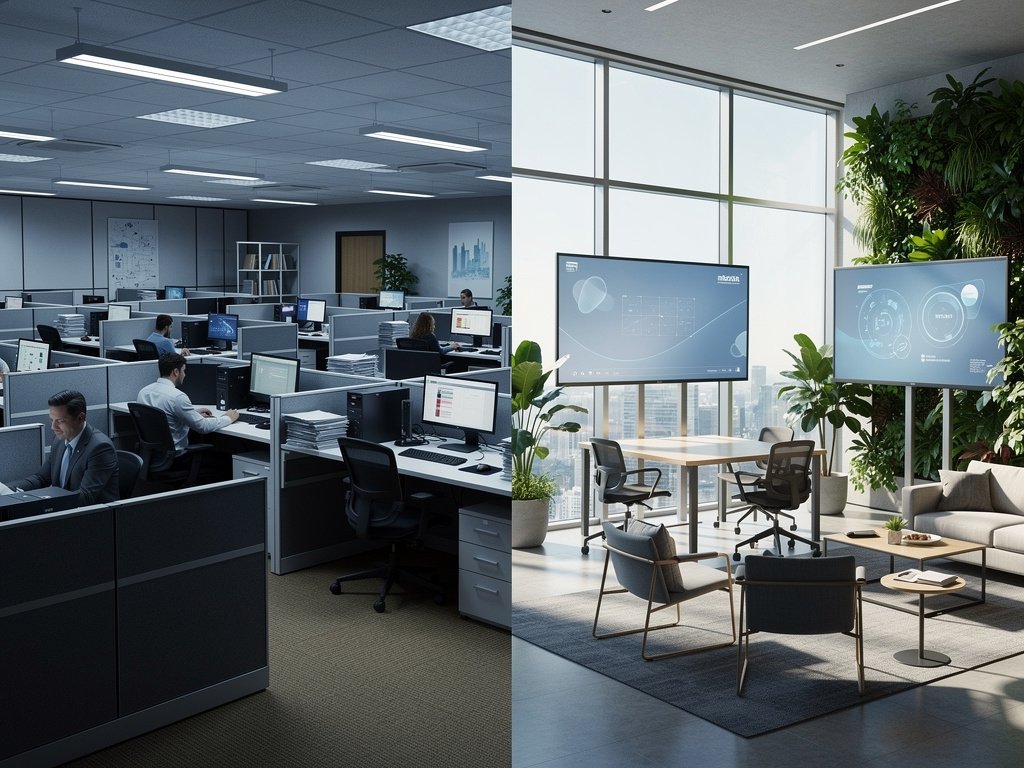
Where We Create Impact
In today’s rapidly shifting business environment, organizations managing multiple office sites face a web of evolving challenges: varying lease term maturities, rigid landlord agreements, adaptive reuse constraints, fluctuating hybrid-work adoption rates, and unpredictable productivity dynamics.
We help you construct an integrated, multi-year business plan that addresses all of these moving parts. Whether you’re planning to exit multiple offices, consolidate locations, convert to flexible work-hubs or redesign for shared-space usage, we model the full lifecycle: from today’s footprint through hybrid-driven transition to the ultimate exit or reuse scenario.
We map out each location’s lease term, renewal options, termination penalties, and reuse potential—identifying critical decision points and avoiding lease lock-in.
We layer in hybrid-office adoption forecasts: how many employees will shift to remote/hybrid, what that means for desk ratios, hot-desking/hoteling, collaboration space, and facility requirements.
We build scenario models showing increasing or decreasing hybrid-office costs, varying occupancy levels, and the impact of adaptive reuse (e.g., converting part of an office to third-party coworking, subleasing, or flexible space), or office space elimination altogether.
This is not a static snapshot—it is a dynamic plan that evolves with your business, your workforce, and the broader real-estate market.
We quantify the multiple levers of value in a hybrid office transformation: Lease and facilities cost reduction — as occupancy drops and footprint shrinks, operate fewer square feet or convert space to higher-value uses. Many firms discover that their cost per productive employee falls significantly through shared/hybrid space models.
Productivity gains from collaboration — by re-architecting your physical space to focus on high-value in-person interaction (brainstorming, ideation, culture building) and pairing with remote/hybrid focused individual work, you unlock higher performance and innovation.
Carbon / emissions reduction — fewer commutes, fewer occupied desks, reduced building energy usage. These contribute to your ESG profile and can yield savings or enhanced brand value.
Bottom-line impact — when aggregated over a 3- to 7-year transition horizon, the cumulative savings, productivity uplift and footprint reduction drive improved margins, stronger free-cash-flow and enhanced exit value for offices you pivot or release.
This kind of transformation demands more than plans—it demands leadership. Our team brings deep experience in workplace strategy, real-estate advisory, change management and financial modeling.
We orchestrate: stakeholder alignment across operations, real estate, HR, finance and IT change-management strategies to engage employees, manage cultural transition and optimize adoption of hybrid models phased rollout and pilot testing to validate assumptions and adapt to real world changes monitoring and analytics, so you track productivity, occupancy, cost savings and environmental metrics in real-time—enabling course correction along the journey.
Multi-site, complex-lease expertise: We’ve worked across multiple offices, across varying lease regimes, local markets, and reuse-scenarios. Robust business planning: It’s not just about space reduction—it’s about modeling for productivity, cost, carbon and exit value across a defined transition path.
Hybrid-work specialists: We understand the human side of hybrid work—culture, technology, layout, employee experience—and how it ties into the physical space.
Outcome-driven: Your success is our success. We focus on measurable metrics—cost, productivity, emissions, footprint reduction—and build the roadmap to deliver them.
Frequently Asked Questions
Hybridization refers to restructuring a company’s office footprint to support a mix of remote work, in-office work, and flexible collaboration space. It includes optimizing real estate, reducing unused square footage, planning multi-year lease exits, and creating more agile work environments.
Organizations adopt hybrid models to reduce real estate expenses, improve productivity, support recruitment and retention, increase operational flexibility, enhance collaboration, and reduce emissions.
We guide clients through office footprint analysis, multi-office consolidation, lease restructuring, desk ratio forecasting, scenario modeling, change-management strategies, and long-term productivity planning.
Yes. We map all lease terms, renewal options, penalties, and flexibility clauses to build an optimal exit or transition strategy, including landlord negotiation support and adaptive reuse planning.
We specialize in multi-site portfolios and build unified strategies that address workforce needs, lease structures, utilization, and financial considerations across all locations.
Hybrid generally increases productivity by supporting focused remote work, improving collaboration during in-office days, reducing commute fatigue, and boosting retention.
We evaluate options such as subleasing, flexible workspace conversions, coworking arrangements, adaptive reuse, and phased downsizing based on financial modeling.
Yes. We model cost-per-employee, lease exit scenarios, facilities savings, desk and conference room demand, emissions reductions, and bottom-line impacts under multiple scenarios.
Most hybrid transformation strategies span 2–7 years depending on lease maturities, workforce distribution, and operational needs.
When implemented strategically, hybrid strengthens culture by supporting intentional in-person collaboration, fostering autonomy, improving communication rhythms, and enhancing employee satisfaction.
Yes. We support communication planning, hybrid policy design, employee adoption modeling, and leadership alignment to ensure smooth transitions.
We evaluate each location based on lease economics, utilization rates, strategic importance, commuting patterns, workforce distribution, and adaptive reuse potential.
We provide deep real-estate expertise, advanced financial modeling, multi-year strategic planning, productivity insights, and leadership-level support that ensures decisions are grounded in both data and organizational needs.
Ready to map your hybrid-office transformation and unlock real business value?
Contact us today to schedule an initial diagnostic of your current office portfolio and explore your multi-year transition roadmap.