
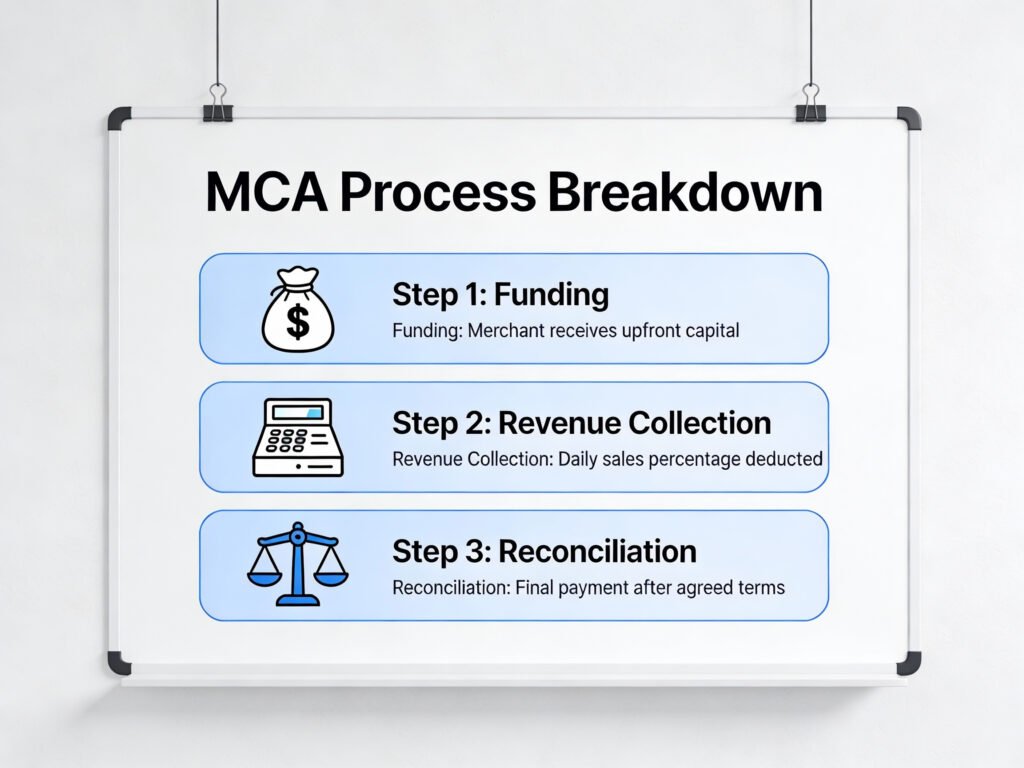
Merchant Cash Advances (MCAs) have become one of the most widely used forms of alternative financing for small and mid-sized businesses in the United States. They are fast, convenient, and accessible even to companies that cannot qualify for traditional loans. For many business owners, MCAs feel like the perfect solution during a financial pinch — whether for inventory, payroll, repairs, marketing, or unexpected emergencies.
But behind their simplicity lies a financial structure that many business owners do not fully understand. And because MCAs are not technically “loans,” they operate under a completely different set of rules, risks, and legal implications.
One of the most important — and misunderstood — components of an MCA is reconciliation, the mechanism that is supposed to protect business owners when revenue declines or when unforeseen operational issues occur. Many owners have never even heard of reconciliation until they seek help, and many funders fail to properly honor it, creating situations that resemble predatory lending rather than a genuine purchase of receivables.
This blog provides a clear and honest explanation of what MCAs are, how they work, why reconciliation matters, and how misunderstandings around MCAs lead to the financial strain seen in many of the featured case studies.
Let’s break this down in simple, practical terms.
Section 1 — What Exactly Is an MCA? (And Why It’s Not a Loan)
A Merchant Cash Advance is legally defined as a purchase of future receivables, not a loan.
This distinction is not just semantic — it is foundational.
When you receive an MCA:
✔ You are selling a portion of your business’s future revenue
—not borrowing money with fixed terms.
The funder provides a lump sum upfront (the “advance amount”), and you agree to deliver a larger amount in the future (the “purchased amount”), usually through daily or weekly withdrawals.
Because MCAs are not loans, they do not follow the same rules as loans:
- No interest rate
- No amortization schedule
- No fixed repayment term
- No traditional underwriting requirements
- No collateral in the traditional sense
This makes them fast, flexible, and accessible — but also risky if misunderstood.
Section 2 — Key Components of an MCA Agreement
To understand MCAs properly, we must understand their parts.
- Advance Amount
This is the lump sum the business receives upfront. - Factor Rate
Instead of interest, MCAs use a multiplier (commonly 1.2–1.5).
If your advance is $100,000 and your factor rate is 1.35:
You will repay $135,000. - Purchased Amount
This is the total amount the funder is entitled to collect (advance × factor rate). - Payment Method — Fixed Daily/Weekly or Percentage of Sales
MCAs were originally designed to collect a percentage of daily revenue, meaning payments naturally decreased when sales decreased.
However, many modern MCAs use fixed daily or weekly payments, which creates a problem for businesses experiencing operational disruption.
We will come back to this — because this is where reconciliation becomes crucial. - UCC-1 Filing
This gives the funder a security interest in your receivables.
It does not freeze your accounts but can complicate financing. - Default Clauses
These describe what triggers a default. Many are extremely broad and easy to misinterpret.
Section 3 — Why Businesses Choose MCAs
MCAs exist for a reason: businesses often need fast capital that banks cannot provide.
Owners choose MCAs because:
- Funding is extremely fast
- Credit requirements are low
- Paperwork is minimal
- MCAs approve businesses banks decline
- MCAs offer emergency liquidity
- MCAs feel less intimidating than loans
This was true in multiple case studies:
- Construction Company: Delays in receivables from large projects created cash strain.
- Print Shop: Equipment downtime required immediate capital.
- Medical Center: Billing disruptions resulted in AR shortfalls.
- Sports Subscription Business: Seasonal fluctuations created revenue variability.
In each case, the MCA felt like a quick, practical bridge.
But the bridge leads somewhere — and sometimes it leads into deeper water.
Section 4 — The Most Important Part of an MCA: Risk-Sharing Through Reconciliation
Here is the heart of what makes MCAs legal and distinct from loans:
⭐ The funder must share risk with the business.
If the business makes less money, the funder must collect less money.
This is not optional.
This is not generosity.
This is a core legal requirement.
The mechanism that enforces risk-sharing is called:
⭐ Reconciliation (also called “true-up”)
Reconciliation is the process that adjusts MCA payments when a business’s revenue declines or when operational disruptions reduce receivable flow.
Section 5 — How Reconciliation Is Supposed to Work
In a true MCA:
✔ Payments must align with revenue
✔ If revenue decreases, payments decrease
✔ If operations slow, payments slow
✔ If business conditions change, obligations change
This reflects a shared-risk relationship, which is the defining distinction between:
✔ A sale of receivables (legal)
versus
❌ A loan with disguised interest (potentially illegal, subject to usury laws)
Reconciliation should be available when:
- Revenue drops
- A key customer delays payment
- Equipment breaks (as in the Print Shop case study)
- Economic conditions change
- Labor shortages affect output
- Legal or regulatory challenges arise
- Supply chain disruptions occur
- Seasonal fluctuations shift demand
- Unexpected emergencies arise
- Major payors delay invoices (common in medical billing)
It is not limited to revenue declines alone — it applies to any legitimate business hardship affecting receivable flow.
Section 6 — The Reality: Many MCA Funders Do Not Properly Honor Reconciliation
While reconciliation is central to the structure of an MCA, many funders:
- Make the process extremely difficult
- Delay reconciliation requests
- Ignore hardship documentation
- Enforce fixed daily payments regardless of business conditions
- Penalize owners when payments become unmanageable
- Act as though payments cannot change
- Treat the MCA like a loan instead of a receivables purchase
This is where problems begin.
When a funder refuses to adjust payments based on a business’s real performance, the MCA becomes:
❌ Loan-like
❌ Risk-shifted
❌ Potentially unenforceable
❌ Structurally predatory
This is a major issue in MCA disputes and restructuring negotiations.
Section 7 — Why Businesses Struggle With MCAs (Even When They’re Making Money)
Contrary to popular belief, businesses do not struggle with MCAs solely because revenue declines.
Many businesses with growing revenue still experience MCA stress because:
✔ Operational costs have increased
✔ Equipment failures reduce output temporarily
✔ Insurance or legal issues create unexpected expenses
✔ New staff or labor shortages affect efficiency
✔ Vendor prices rise
✔ AR delays slow incoming cash
✔ The business is in a seasonal downturn
✔ Multiple MCAs are stacked simultaneously
✔ Fixed payments outpace daily cash inflow
The Medical Center Case Study is the perfect example:
Revenue was not the main issue — AR disruptions were.
This caused cash shortages even though patient volume remained strong.
A funder who refuses to adjust payments based on these realities is not sharing risk — they are enforcing a rigid payment structure that does not reflect the MCA model.
Section 8 — When an MCA Begins to Resemble a Loan
Regulators and courts often evaluate whether an MCA is truly a receivables purchase or whether it functions as a disguised loan using the “economic reality test.”
Red flags indicating “loan-like” behavior include:
❌ Fixed payments that do not adjust
❌ No meaningful reconciliation option
❌ Funders demanding repayment even when revenue drops
❌ Funders avoiding shared risk
❌ Contract terms that penalize business hardships
❌ Payment obligations that resemble amortization
❌ Requirements that shift all risk to the merchant
The more the MCA behaves like a loan, the more it risks falling under:
- Usury laws
- Interest caps
- Lending regulations
- Court challenges
This becomes a powerful leverage point in negotiation — handled professionally.
Section 9 — When Problems Arise: Why DIY Does Not Work
When businesses struggle under MCA payment pressure, many attempt to negotiate directly with funders.
This often leads to:
- Miscommunication
- Accelerated pressure
- Legal threats
- Loss of negotiation leverage
- Misinterpretation of hardship
- Contractual complications
MCA language is nuanced, and funders often interpret business attempts to explain hardship as “avoidance,” even when that is not the case.
The Douglass Advisory case studies repeatedly show that professional communication dramatically improves outcomes.
For example:
- The Construction Company benefited from structured financial modeling and third- party negotiation.
- The Medical Center was able to stabilize cash flow when professionals aligned AR workflows with MCA restructuring.
- The Sports Subscription Business avoided escalation from multiple funders through coordinated intervention.
- The Print Shop regained liquidity once repayment obligations were adjusted through structured negotiations.
This is because restructuring experts understand how to document hardship, reference reconciliation rights, and present the business’s position clearly and strategically.
Section 10 — What Life Looks Like When an MCA Is Properly Managed or Restructured
Once MCA obligations are brought into alignment with actual business performance, companies often experience:
✔ Restored cash flow
✔ Stabilized operations
✔ Improved vendor relationships
✔ Reduced stress
✔ Renewed financial visibility
✔ Confidence in planning and growth
✔ Healthy receivable management
Our case studies highlight this consistently:
Businesses across multiple industries stabilize rapidly once MCA payments reflect reality, not rigidity.
Conclusion — Understanding MCAs Means Understanding Risk-Sharing
A Merchant Cash Advance is not a loan.
It is not supposed to burden a business with fixed payments regardless of circumstance.
It is not supposed to shift all risk to the business owner.
A true MCA:
✔ Moves up when the business does well
✔ Moves down when the business faces hardships
✔ Shares risk
✔ Reflects actual receivable flow
✔ Provides flexibility during disruptions
When this risk-sharing breaks down — either because the structure is misunderstood or because a funder fails to honor reconciliation — businesses can suffer immense pressure.
The good news is:
⭐ With proper guidance, MCA obligations can be brought back into alignment.
⭐ Businesses can recover fully — just like those in the case studies.
⭐ The path to stability begins with understanding the structure and seeking professional support early.
You do not have to navigate MCA pressure alone.
Your situation is solvable, and your business can regain control.